Bloomington, IL · Garage Door Service
Garage Door Repair in Heyworth
Garage door repair for Heyworth's mid-1970s housing stock, serving all 952 households from our Bloomington shop 11 miles away. Call for the fix, not a pitch.
- Repairs & new doors
- Springs & openers
- Serving 5 nearby communities
What Causes It Around Here
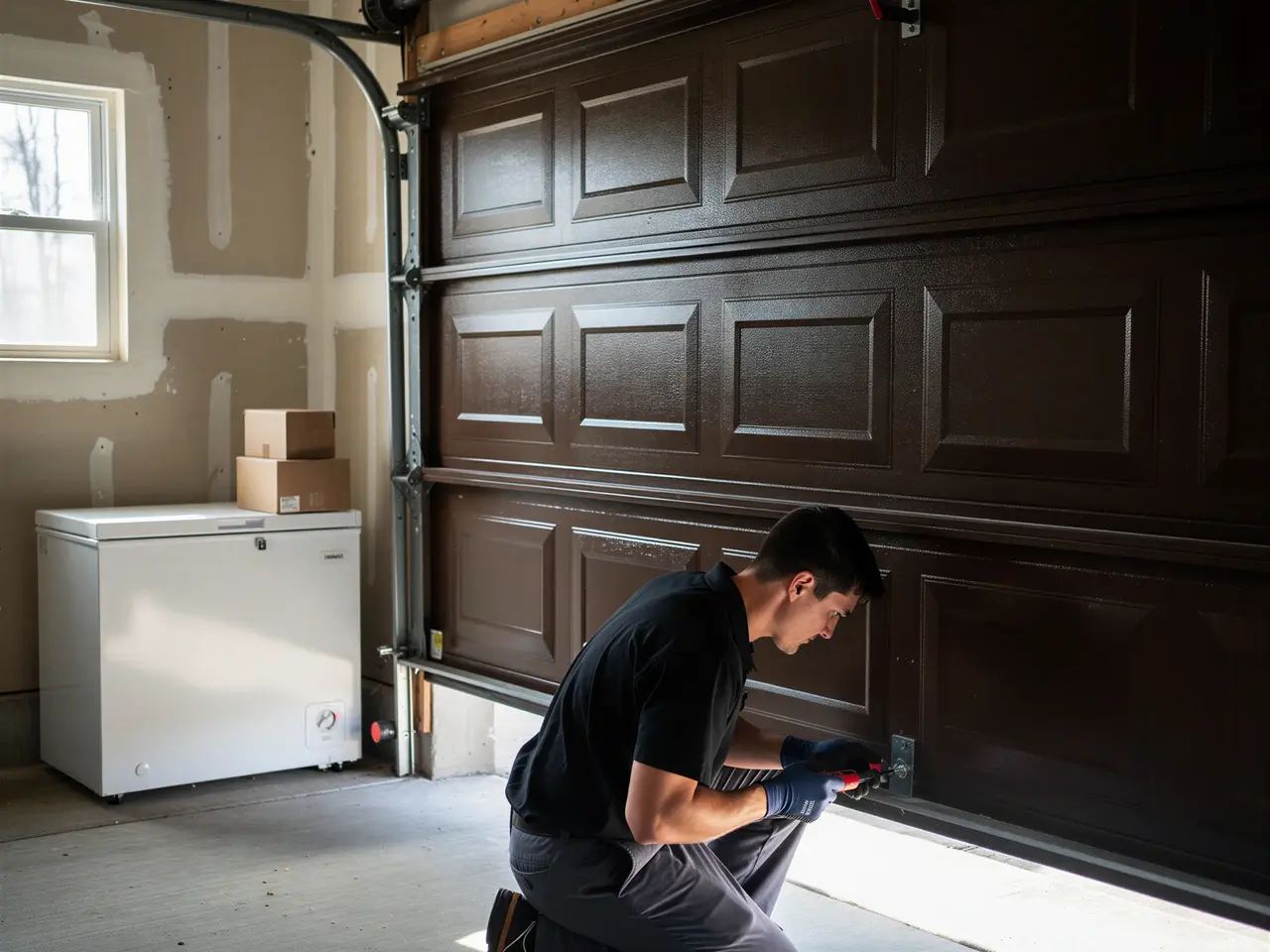
Heyworth's median home dates to 1976, which puts most garage doors here squarely in the steel-and-wood transition of that decade. A lot of these are single-layer steel sections on a basic extension spring system, sized for the two-car openings that became standard in that era. No insulation core, no vinyl backing - just a steel skin that dents easily and a spring setup that wears out on a predictable schedule, not a long one. After close to fifty years, the rollers are the original steel type, loud and pitted, and the track alignment has usually drifted from decades of the door racking slightly on every open and close. In a cold-moderate climate like central Illinois, steel contracts in winter and the extension springs - already the weaker, shorter-lived design compared to torsion - lose tension faster. That combination is why Heyworth service calls skew toward broken springs and seized rollers rather than the opener electronics you'd see on a newer build. The fix is usually mechanical, not digital, and that keeps the job simpler and the parts more available than you'd guess for a door this age.
How Long You Are Without the Door
We run out of Bloomington, 11 miles from Heyworth, so there's no local branch sitting around the corner - a call means a truck making that drive. For a straightforward spring or roller job, that distance adds minutes, not hours, to the visit once it's scheduled. What actually determines how long your door sits broken is parts: common extension springs and standard rollers we usually have on the truck, but an odd-sized panel or an obsolete opener board can mean an order and a second trip. We'll tell you on the first visit which category your repair falls into, rather than guessing over the phone.
The DIY Question
Extension springs under tension are not a safe solo project - they store enough energy to snap a cable or whip loose and that's true whether the door is five years old or fifty. On a 1976-era door, there's an added wrinkle: the hardware often doesn't match anything on a current hardware store shelf, so a DIY swap can end with a part that's close but not right, which stresses the opener and the track in ways that show up as a second failure a few months later. Tightening hinges, lubricating the track, and clearing debris from the sensor eyes are all fine to do yourself. Spring replacement and cable work on a door this age are not, mostly because the margin for a wrong part is higher than on newer stock.
Parts We Carry
For a town built mostly in the 1970s, the parts list that matters is extension springs, steel rollers, and standard torsion conversions - we carry the common sizes on the truck because they come up often across this part of the service area. Original hardware from a 1976 build sometimes isn't made anymore, so where an exact match isn't available, we fit a current equivalent that works with the existing track rather than forcing a full rebuild. Panels are the one item we don't stock broadly - a dented or cracked steel section from this era is often a special order, since manufacturers have moved on to different profiles and gauges. If a full panel match isn't realistic, we'll say so and lay out the replacement option instead of pretending a patch will hold.
How It Shows Up
On a door built around 1976, failure usually announces itself as the door hesitating a few inches off the floor or refusing to close the last foot - a classic sign of a weakening extension spring losing its half of the lift. Grinding or popping from the top of the opening is often a roller near the end of its run, especially after a cold snap. A door that slams down instead of lowering smoothly points to a cable or pulley giving out, not the opener. These are the same symptoms across the roughly 952 households in Heyworth with doors from this era, since they're carrying the same hardware generation - which is also why a repair call here tends to be diagnosable before the truck even leaves Bloomington.
How to Book
Call or request service online and tell us the door's approximate age and what it's doing - hesitating, grinding, refusing to close. That's enough for us to load the right parts before the 11-mile drive out from Bloomington, which cuts down on return trips for anything but the rare special-order panel. We serve Heyworth as part of the wider McLean County area alongside Downs, Towanda, and the other nearby towns, and the scheduling works the same regardless of which one you're in.
Frequently asked questions
Why does my garage door from the 1970s keep breaking the same way?
Most Heyworth doors date to the mid-1970s and use extension springs and steel rollers that have a shorter working life than modern torsion systems. Once those parts near the end of their run, you'll see repeat failures - a new spring on an old roller setup, for instance - until the whole wear-prone assembly gets addressed at once rather than piece by piece.
Do you have a branch in Heyworth?
No, we work out of Bloomington and cover Heyworth as part of the surrounding area, about 11 miles out. There's no local depot, just a truck dispatched for the job, so scheduling a call ahead of a known problem - rather than waiting for a full breakdown - gets you a smoother visit.
Can you match the original hardware on an older door?
Sometimes. Standard rollers and springs from that era usually have a modern equivalent we stock. Panels are the exception - a dented or cracked steel section from a 1970s build is often no longer made in that exact profile, so we'll tell you upfront if a full panel replacement is the more realistic option.
Is it worth repairing an old door versus replacing it?
Depends on what's failing. A spring, roller, or cable job on an otherwise sound door is almost always worth doing. If the panels themselves are dented or rusted through and no longer matched by current stock, repeated patch jobs start costing more than a replacement door would.
More garage door services in Heyworth
Book garage door service in Bloomington
Call now or request a quote - tell us what the door is doing and where you are.