Bloomington, IL · Garage Door Service
Opener Repair for Hudson's 1980s-Era Garage Doors
Hudson homes mostly date to the late 1980s, which means a different opener problem than the rest of the service area. Here's what actually fails and how we fix it.
- Repairs & new doors
- Springs & openers
- Serving 5 nearby communities
How It Shows Up
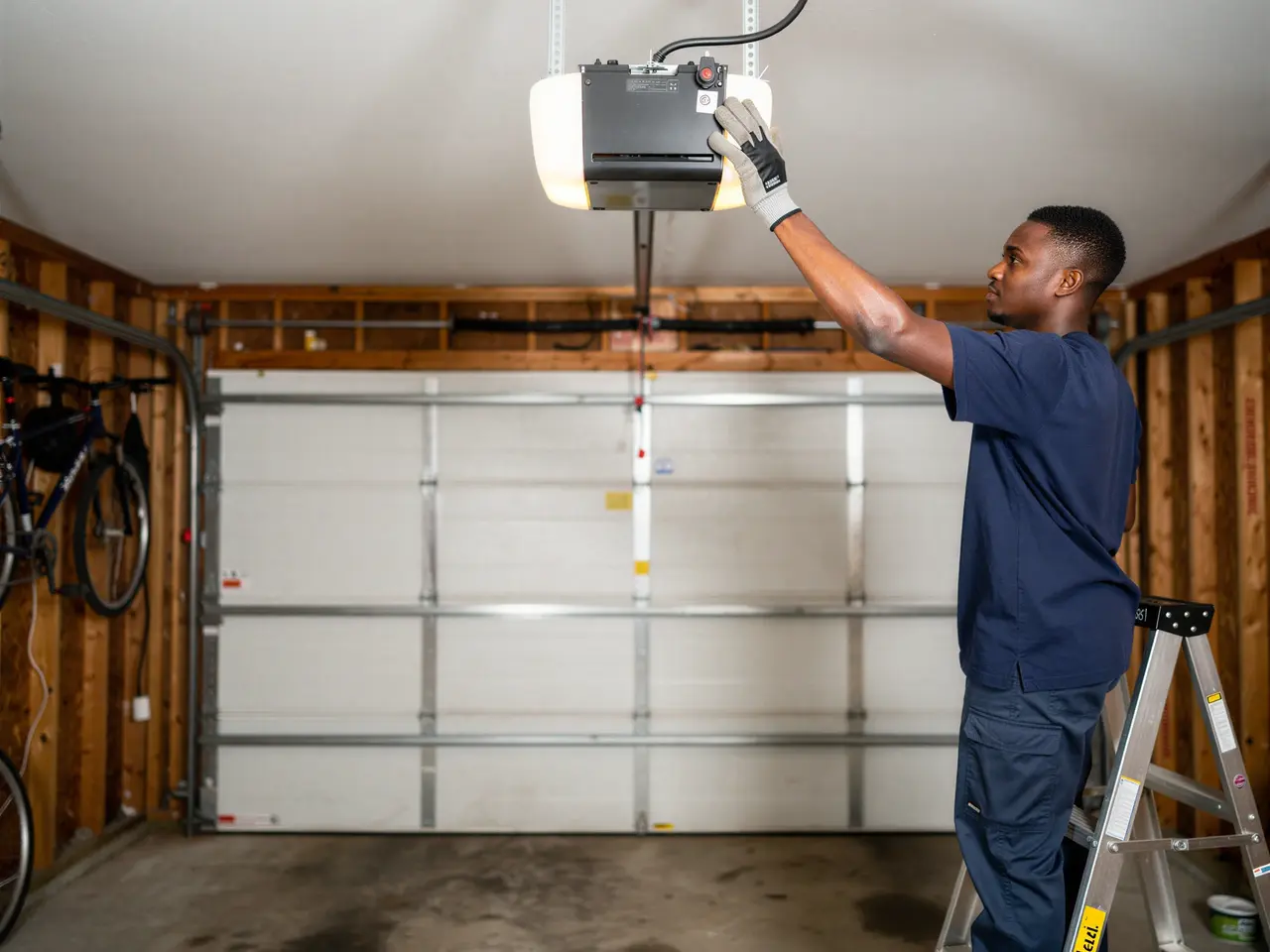
In Hudson, the opener call almost never starts with "it won't open at all." It starts with a unit that runs but doesn't pull the door, or one that reverses halfway up for no reason anyone in the house can explain. That pattern lines up with the housing stock here: Hudson's median build year sits around 1987, noticeably newer than the 1970 median across the wider service area. A door installed when a house went up in the late '80s has almost certainly had its opener swapped once already, sometimes twice, which means what's hanging over the car right now is a second or third-generation unit, not the original. Those units are old enough that drive gears strip, capacitors weaken, and logic boards start throwing intermittent faults - but they're also young enough, and installed well enough, that the hardware around them (track, springs, mounting) is usually fine. That's the Hudson pattern: the motor and board are the problem, not the whole system. We still check the rest before we touch the opener, because a worn roller or a sagging track can mimic an opener fault and send you chasing the wrong part.
Where This Job Goes Sideways
The trouble starts when someone reads a blinking light code off the opener manual and orders a part online before anyone's looked at the actual unit. Opener boards from different manufacturers use different blink patterns for the same symptom, and a board built in the late '80s or early '90s often isn't a straight swap for whatever's sold today - mounting brackets, wire harnesses, and remote protocols have all changed since then. We've also seen Hudson jobs where a homeowner replaced the opener but kept the original wall switch or safety sensors, and the mismatch caused the new unit to behave like it's still broken. The other way this goes sideways: treating a spring problem as an opener problem. If the door is heavy to lift by hand with the opener disconnected, the opener isn't your issue no matter what the remote does.
How We Fix It
We start by disconnecting the opener and lifting the door by hand. If it moves smoothly and holds position on its own, the opener is the actual fault and we move to diagnosing the motor, drive, and board. If the door is heavy or won't hold, we stop and talk about the spring system first - fixing the opener wouldn't solve anything in that case. For an opener that's confirmed faulty, we check gear wear, the capacitor (a common failure point once a unit's been running a decade or more), the travel limit settings, and the safety sensor alignment before we recommend parts. Some of Hudson's opener models still in service are old enough that exact replacement boards aren't stocked by any manufacturer anymore, which affects how fast we can get a matching part versus how fast we can get a comparable one.
What Causes It Around Here
Hudson sits in a cold-moderate climate zone, same as the rest of the area, and that shows up in openers the way it shows up in car batteries - cold tightens drive belts, stiffens chain lubricant, and makes marginal capacitors fail on the coldest mornings rather than gradually. Combine that with a housing stock centered on the late 1980s and you get a specific failure window: openers installed or last replaced 10 to 15 years ago are now hitting the age where gears, belts, and boards wear out together instead of one at a time. With Hudson's median household income at $114,125 - meaningfully higher than the broader service area - we also see more owners choose a full belt-drive replacement over patching an aging chain-drive unit, since the cost difference matters less here than the quiet and reliability do.
The DIY Question
Resetting travel limits or cleaning sensor eyes is reasonable DIY territory, and plenty of Hudson owners handle it themselves. Replacing a logic board or a drive gear on a unit that's a decade or more old is a different matter - you're often buying a part for a model number that's been discontinued, and a near-match part can cause the exact intermittent behavior you were trying to fix. Our honest limit here: if your opener is old enough that we can't source a matching board, we'll tell you straight that full replacement is the cheaper and more reliable path, rather than quoting you repair parts that might not hold.
How Long You Are Without the Door
We run out of Bloomington, about 9 miles from Hudson, so we don't promise a same-day slot the way a shop sitting in town might - we fit Hudson calls into the day's route rather than dropping everything. Once we're on site, most opener repairs - gear, capacitor, board swap, sensor realignment - are a single visit. The exception is a board that's old enough to need a non-stock replacement; in that case we'll tell you the lead time on the part up front rather than leave the door hanging. With 685 households in Hudson, we see enough of this specific build-year pattern to know what we're walking into before we knock.
Frequently asked questions
Why does my opener work but the door won't move?
Usually the motor is running but the drive gear inside the opener has stripped, or the chain/belt has slipped off the rail. Both are common once an opener passes the ten-year mark. We check this before quoting anything else.
Is my opener too old to repair?
If it's a late-'80s or early-'90s original unit, the odds of finding a matching board are low, and we'll say so rather than order a part that won't fit. Most Hudson openers we see have already been replaced once and are newer than that.
Do you carry opener parts on the truck?
We carry common wear parts - capacitors, sensor eyes, limit switches - for the opener models we see most. Boards for older or discontinued units sometimes need to be ordered, and we'll tell you that lead time before we leave.
Can cold weather really cause opener problems?
Yes. Cold stiffens chain lubricant and drive belts and pushes a weak capacitor past its limit, which is why opener calls climb in the coldest stretch of winter here same as anywhere in this climate band.
Book garage door service in Bloomington
Call now or request a quote - tell us what the door is doing and where you are.